The Face at Vesper Manor
My editor told me it was about time for me to write something new; something relatable; timeless, because the two manuscripts that I’d finished, per my contract, were no longer needed. He told me that what I’d originally agreed to write for him wasn’t special anymore. Nobody would read it. He said it was too much like my life, about my otherness, about wanting to break out in literary circles.
I needed the money and the reassurance, though most of the latter seemed to stem directly from positive reinforcement on my writing, so I took his advice.
It took me two and a half years to finish those manuscripts. Presently, it was November. It felt wrong to start something new so late.
The few extraordinary things that happened were already splashed in the Town Topics until they lost their magic. In order to write something truly spectacular, I needed to get as far as possible from the house.
My husband was away working in the city. There was an influenza breakout sweeping through the seminary where several people had already died. He, along with a few other doctors and nurses from the hospital, volunteered to treat the sick.
I wrote him a letter to tell him that I was going to be away. I knew he wouldn’t mind. He was indifferent about my work, which I greatly appreciated because I hated talking about what I was writing until it was finished. After all, everyone was writing a novel. I was bad at pitching my books too – they sounded childish and overimaginative.
But I was fascinated by my husband’s work and often bothered him with questions which he didn’t always know how to answer because there were so many prerequisites to first establish to even get to the root of my original inquiry. His brain worked differently than mine. While his remembered numbers and adjusted to working under pressure, mine focused on words and froze when put on the spot. Writing was good for me – quiet and non urgent. His work was frantic. On the outside, it seemed like his work didn’t wear him down, but recently, before he went off to the city, he’d come home barely able to open his eyes, muttering praises for the stew I made for him.
A week ago, he came home unable to turn the key in the lock of our front door. I found him there with his cheek pressed to the wood, dozing.
“Rough day,” he said once I dragged him inside. “A woman came in, maybe 25 or 26. Said she was seeing things.”
I held his head up while he drank water. “What was wrong with her?”
“Psychosis. Managed to get a history out of her. It turned out her mother was the same way.” He shrugged. “Maybe she was a witch.”
“What causes psychosis?”
This was the much needed fuel for my imagination since I couldn’t encounter this myself.
“Many things.”
“Can it be hereditary?”
“Many things can be, but I can’t say for certain about this.” One corner of his mouth lifted while his eyes fully closed. “I’d put my money on spirits instead.”
“Spirits?” I was amused. I’d never heard him talk like this. “As in possession?”
“Oh, yes. Sometimes things are just unexplainable.”
“Do you think this woman’s psychosis is unexplainable?”
He didn’t answer for a moment. I shoved his shoulder to rouse him. He grunted and muttered, “Haven’t figured out a cause yet.” Then he fell asleep.
I crouched before him for an extra moment, thinking. I draped a thick blanket over him. Recently, he’d been coming home with a harsh chill in his bones, shivering while he slept. Even in his sleep, he’d whisper when shifting around, “So cold. So cold.”
It was indeed very cold that winter. We were running low on wood already. All our money was getting fed directly into the mouth of our landlord. The manuscripts I’d written were meant to hold us over until at least February. If my husband wasn’t at the hospital or receiving a request for a house visit, he was on the front lines treating frostbite and hypothermia. Many people froze to death or passed from starvation in those months. They were dropping faster from those circumstances than consumption. Because the ground was solid, burials happened slowly. At any given moment, there were at least 5 or 6 small coffins waiting to be put to rest.
When I asked about the woman many days later, my husband told me the woman had cut her wrists and bled out in her hospital bed.
Aside from getting inspiration for stories, the idea of hereditary illnesses greatly intrigued me. The body could be so helpless in the face of its own misfortunes. I thought about the deceased woman for days. I had not even asked her name. Surely no woman or man wanted to experience that. Seeing things that weren’t there, hearing sounds that couldn’t possibly exist in our realm, even having certain thoughts that were so unwarranted, it was impossible to pinpoint where they could originate from. But these things happened to people, like my husband’s patient and her mother.
It also made me nervous, but my husband didn’t seem to be affected by these cases.
He had a calm nature, never fighting against his natural, God given urge to remain docile, collected, which I could clearly trace back to his family.
My family, however, was a strict straight explanation to how I was: overly nervous and at times frightened for no apparent reason. I’d brought up my case to my husband many times, expecting some sort of an explanation, but he insisted that some people just were different and that didn’t necessarily mean anything was wrong.
Nothing was wrong, yes, but our dispositions were too different to ignore.
I could perhaps blame it on our upbringing, but the reason for that had been our parents’ natures. My mother could not possibly raise a child that ended up like my husband. In fact, all my siblings turned out the same way, overbearing in one emotion: anger, nervousness, apathy.
But if the matter of the patient’s psychosis was because of outside factors such as spirits or possession, maybe there was an experiment I could perform. I would use myself as bait for a genius idea for a novel.
Vesper Manor was riddled with rumors of demons and monsters, of terrifying dreams. Apparently people who visited the place never returned back the same. A part of them was somehow lost within the manor or maybe the mountains. I knew from accounts around the small town that the visitors, though they looked the same, existed as if an essential part of their essence had been bitten out of. They sometimes stopped mid sentence and stared out into the distance in horror as if expecting something to come out and maul them. They adopted an odd gait. They cut their hair and painted their nails dark colors and, sometimes, appeared to speak to people who weren’t there.
How perfect. I would see which phenomenon could alter the mental status of a person more: supernatural elements or genetics.
Thus my new project was born. At that point, I was still naive. Inherited behaviors seemed more likely than spirits. Tangible. Proven by science.
I also thought returning in an altered state would not be so bad for me. With the way I carried myself – well, there was no way I could become worse.
II.
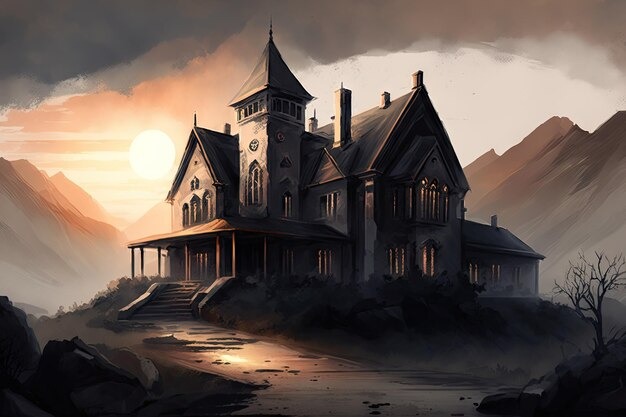
Vesper Manor was located on the highest peak of the Northern Mountain, bordering the barren area that divided two countries. Those mountains were a popular destination for the wealthy when it was the right season as they enjoyed skiing, snowboarding, and even camping in nearby cabins. When temperatures took a drastic turn, typically November into December, the place became sparse of people. The wealthy traded their hobbies in for more tame activities such as lounging at the beach down south to cling onto the limited warmth before the festivities of the new year.
The manor was a source of great intrigue for those that could afford it. People could rent the entire manor for an entire month if they wished, but I used the remainder of money from my previous manuscript plus a little of what my husband had given me to book the east wing of the manor for two days.
The carriage took me as far as it was willing. I stood at the trough of the mountain with my duffel bag. By the time I got to the front gate, I thought the driver would be long gone, but instead found him waiting at the bottom. I dropped my bag and gave him a tremendous, overexaggerated wave. He hurried away.
There was no doubt that the estate was large and grand, but seeing it with my own eyes made the grandeur of it even more unreal. It towered, peaks hidden by the low clouds of that winter that were filled, likely, with ice, black brick on the exterior save for the door which was wooden and at least three times my size. It gave way almost immediately when I inserted the key left beside the door for easy access, as if it didn’t need the key’s permission to allow a visitor. It opened, friendly, and drafted me indoors with a warm caress.
I expected the conditions to be frigid inside, but was pleased to find an inviting foyer with a chandelier swinging gently above, matching the wind that brought me in. It cast a golden light. I was struck with a foolish sense of nostalgia as if I’d been through these halls before, but that was too silly of a thought to dwell on.
My footsteps echoed through the chamber. I marveled at the rich architecture. It was anything but the scary works I found drawn by artists that dared to stay here. Instead, it was vibrant with color, dark green and red on the walls, a golden tapestry leading into the first drawing room, and a brown carpet under various well dusted furniture to ensure the royal look.
Portraits of previous owner and contributors to manage the upkeep of the manor were lined up in chronological order in the drawing room, and above the fire mantel was the largest oil painting of them all: an austere looking woman with eyes that tilted down and a severe jaw. I walked back and forth the length of the room and her eyes followed me. She must have been only a few years older than me. Her hair was still black with a single ribbon holding her braid laid carefully over her shoulder, curly strands framing the rest of her face. She cradled a sleeping baby in her arms. Ms. Victoria Jewel, 1829.
I started a fire, though there was no need for it in this well insulated manor, but it completed the picture. The fire mantel had a few trinkets on it, two different sizes miniature grandfather clocks, a metronome, and a sculpture of a weeping fairy with looming purple wings.
It was utterly enchanting. I fell into the seat before the fire, pleased at my confidence to come here. This would be a perfect place to start a new story, so different from my smaller cottage that never seemed to warm properly despite the fire smoke wafting through the home daily.
Moments later, the door to the drawing room opened. I hadn’t realized that I’d shut it. In came a young woman in servant clothing, rolling a tea tray.
“Miss Hester,” she said softly. “Welcome. Please have some tea.”
“Hello,” I returned. “Thank you very much.” I took the outstretched tea and rested it on the slim coffee table beside the chair. “This place is lovely. Your upkeep of it is marvelous.”
The girl blushed as red as her hair and cheeks and ducked her head. “It is a joint effort.”
“Oh. What’s the staff number here?” I had not been given any information on this from my travel agent and nothing from the rumors. The whispers never even mentioned any staff.
“There’s four of us, miss. I manage the east wing and first floor. Mr. K manages the west wing and the second floor. Mrs. P is the cook – she’ll make anything you want, miss. And then there’s Mr. J, the majordomo. He appears here and there, though mostly makes himself scarce. Says he trusts us to run the house smoothly.”
By her weak flush, I assumed this woman had a soft spot for the majordomo or at least intense admiration. “And what’s your name?”
“Oh, I’m Penelope.”
I smiled. “No secrecy there?”
“The names of the staff aren’t meant to be secret,” Penelope assured me, offering a plate of cinnamon biscuits which I immediately accepted. “It’s just that I don’t know their full name. That’s how they’ve been introduced to me.”
“You’ve not been here long then?”
“No. Just six months.” She glanced behind her as she straightened. “While you’re on the lower floor, please feel free to call for me. The house is old and the echoes will indeed hold so I’ll hear you. There’s nothing too grand to ask for, miss.”
“Thank you.”
“Would you like a dram of whiskey? It can get chilly at night and I wouldn’t dare wish for you to be cold. It’ll hold you over until morning.”
“No. I don’t drink.”
“Sure, miss.” She did a little bow, which was rusty, and then withdrew from the room.
I lowered myself to the ground and took out all the essentials from my bag. Textbooks, notebooks, my pen, two pots of ink, loose paper for notes, and a few novels. I found that I needed some sort of nourishment when writing a different genre and I could only find that in other novels that were similar in what I wanted to write.
I set off to write about monsters, shadows, and ghosts, which this manor was supposedly enriched in, so before me sat Beowulf. What I derived from most horror stories about the others was that they were inverted versions of humans. How we learned to exist through empathy and seeking sustenance in food, careers, and relationships, the other beings found in their own way.
As a child, I was fascinated with the various creatures from other cultures: jinns, wraiths, daemons. Just like the entire population of humans could not be characterized as good people, not all creatures were inherently bad. I simply could not believe that, if I could even believe in their existence outside of scaring children into behaving.
However I did believe in ghosts, though I considered them to be the most tame of the supernatural creatures. They were once real beings, humans or not, so they knew the weight of existing. They lingered between life and death now, and it was probably agonizing. I couldn’t fear them. Instead I pitied them. I imagined myself floating through the universe without a meaningful connection with either plane of existence. When I thought I could sense an apparition, I never paid much attention. I thought they might be humiliated by the attention they received.
The clouds had rolled in fully over the manor and gentle rain began hitting the windows. The heavier the rain became, the quieter the fire crackled before me. The gentle sounds were intoxicating more than any drink could be and I found myself leaning my head back on the seat, writing on my parchment of notes with half lidded eyes.
I hadn’t slept well the past few nights, fretting over the end of my career, worrying over my husband who I thought might return afflicted with the plague, and half regretting the decision to rent the manor for two days because there was a chance I would return as a changed woman. When I rose at dawn, I thought my worries were silly, but when night came again, they circled around my head like a fever that simply would not break no matter how much I perspired.
It was always a race to write down my thoughts before they escaped into my sleep, drifting away like smoke from the bright embers before me, into the deep night. I needed to collect them before they left my head without any signs of returning.
I believe I got most of my thoughts down before sleep engulfed me.
III.
I did not sleep for long. A loud bang woke me up from my slumber, setting my heart off. I glanced around wearily but found nothing that could have made the noise. Perhaps it was the weather. The rain had transformed into hail, pelting against the windows as if begging to come in. I stood and walked over to the window, peering outside. The east wing faced the town. When I squinted, I could see the thin, weak lights of the city.
Triumph gleamed in me; I had gotten away.
The doors to the drawing room opened again. Penelope emerged with another woman with a tight bun and servant clothing. The smell of well spiced food accompanied them.
“Miss Hester,” the woman said. “I am Mrs. P, the cook. I hope the dinner I’ve made is sufficient for you.”
I neared her. Mrs. P’s eyes were strict, mouth tight with evident disapproval, and hands worn from overuse. She set the tray before me on the coffee table and gestured to each dish.
“Fret not,” she continued before I could thank her. “No alcohol or fish were used in the cooking of this meal.”
There was baked chicken with a glaze, asparagus, potatoes, and a tall pitcher of water besides a slice of blueberry pie.
“I could have come to the dining room,” I protested. “I do not want your drawing room to get dirty. Please, let us go to the table.”
“No,” Mrs. P said, her words slicing through the air. “The heat does not reach the kitchens or diner. You are our guest and your comfort and safety is our top priority. And for the sake of your child, please do not sit on the floor again.”
I sharply glanced back up from the food. My hand flew to my stomach. “Sorry?"
Her smile was thin but stretched across her face like leather. It looked unnatural. Like someone was manually pulling her muscles apart with an invisible string. “It is very clear.”
Despite how far along I was, I was not even remotely showing due to my small frame. I enjoyed this liberty. People still treated me like a childless woman.
I dropped my hand and sat in the chair under Mrs. P’s watchful gaze and Penelope’s distracted smile. The maid was idly looking at my notes on the floor. I would be embarrassed by it if my handwriting were more legible.
“Thank you,” I forced out. “This looks lovely. Please rest for the night. I doubt I will be needing anything.”
Penelope straightened and returned to the presence as if it were her cue, light in her eyes again. “Do not hesitate to call for me.”
“I won’t. Thank you.”
They withdrew from the room. The hunger that settled in my stomach was now reduced to flutters. For the most part since finding out I was with child, I ignored its presence. If I thought about it too much, it manifested into my dreams and worried me too much.
I looked down at my scribbles and read what I’d managed to get down before falling asleep. The food was delicious and once the anxiety melted away, I was left ravenous. I chugged the water and ate the pie and silently wished I had another slice. If I ate more, I’d surely go back to sleep, so I went back to writing instead.
The story was rapidly developing the longer I sat in the house. I was feeding from its energy. The story was about a young girl who’d inherited the house as well as the monsters and shadows that came with it. Past owners as apparitions haunted her decisions to renovate the place. They sought to kill her. The housekeeper was possessed by an ancestry of the owner, disguised as a friend to the young girl.
I needed to include an exorcism in there so I started researching through my books to be prepared to write such a difficult scene authentically.
The hours ticked away like this. I fell into a concentrated stupor. My hand ached from how fast I wrote but it felt euphoric. Nothing could beat this sensation.
I was pouring more tea for myself when I heard a noise just outside the doors. Excited, I got up and decided to tour the house a bit more for inspiration. I crept out and peered around, giddy. The corridor leading to the kitchen was clear. Mounted lanterns glowed amber and lit the way. The Persian carpet crunched beneath my feet. I ran my hand along the way as I explored.
I imagined having this place just for my husband and me. We would no longer worry about money or surviving any winters. We’d sleep warm and with full bellies.
When I neared the kitchen, the noise came again. I drew closer. Sitting on the thickly cut oak table was a man dressed in a black suit, hair cascading nicely over his brow, and in his lap was Penelope. He held her tightly, drinking her quiet giggles. He kissed her cheek and his hand slid down to her neck.
I hid myself behind the door and watched for some time before returning to the room.
Something felt off when I entered the drawing room. It looked exactly how I left it, but it was off kilter, the colors a little bleak. The fire was roaring healthily in the fireplace and my books remained scattered on the floor, but the air was icier.
Perhaps there was a window open somewhere in the room. When I paced around the perimeter, I found all the locks bolted. The wind whipped outside.
I turned back to my books. It was then that I realized I wasn’t alone. In the middle of the room stood a shadow, several heads larger than me.
When it moved, the old floorboard didn’t creak. It didn’t introduce itself. It prowled like a fox, flickering about. It wasn’t human.
“Penelope!” I shouted. Maybe someone was playing a joke on me. A tactic to scare those foolish enough to stay in the house. “Mrs. P! Someone come quick!”
With how fervently Penelope told me to alert her if I needed anything, I expected her to come straight away. But nobody entered the room.
“Someone! Someone help me!”
The shadow glimmered and moved slowly. When it was clear that nobody was coming to my rescue, I picked up my skirts and shot against the room. I gripped the hot poker from the fireplace and held it out.
The thing neared. The closer it came, the more weak I felt, like someone was unspooling my energy from the inside. It sort of looked at the poker, disinterested, and then tittered, engulfing the iron rod into where its chest would be.
It swallowed it whole with a loud squelch.
Slick fear trickled down my spine. The figure grew against the mantle, darker than a shadow but blurred at the edges. It dimmed the fire, making the room even colder. I commanded my legs to move so I could get the hell out of there, but I was frozen, entranced.
The thing hovered over me. Where its mouth should have been was a gaping black hole. It was as if it was sucking in all the air in the room. Within seconds, I felt faint, a deep throbbing erupting behind my ears, then my eyes. My throat was stuck. My fingers itched to claw at my throat. I imagined dragging my nails into my jugular to pierce my windpipe and force some air manually, blood dropping over my white sleeves.
It neared until it was in my face.
“Scared,” it whispered. Then screeched in a high pitched voice, “SCARED!”
I choked on a desperate breath. I could feel my eyes beginning to pop out of their sockets. It reached a cloaked hand out and wrapped it around my neck, lifting me from the floor. Consciousness was beginning to leave me. Black spots danced before my eyes, tears drenching my skin. I opened my mouth in a soundless scream.
It entered my body within a second, forcing itself down my esophagus and circling by my lungs and stomach to cruelly find a place to make its home. I could feel its cold claws around my organs while it wandered around, almost playfully, like a child would climb over his mother when bored. I felt it like a heartbeat over my slowing one, a thin laugh in my head, and when it slithered up to my brain, I was petrified. My body was no longer mine.
I crashed back down onto the seat. Limply, I let the thing assault my insides, seeking through my memories and central system like a parasite, drinking all the fuel I had in my veins. I sat there in agony, unable to force it out of my body, nor make a single noise of complaint.
It was much later when the thing escaped out of me through my tear ducts, eliciting a reedy shriek from me. I was now on the ground, the heat from the flames close enough to my face to singe my eyelashes. The shadow hovered over me, watching intensely as I slid back upright.
Frantically, I wiped my eyes. My hands came back marred with streaks of black, old blood. A scream whistled through me.
The thing settled in front of me. I could see its long cloaked legs, spindly toes with cracked nails. It beckoned closer, enclosing its thin fingers around my jaw. With a yank, it forced me to look into the face of my attacker.
I found myself looking into the gentle, large brown eyes of a child. I tried to throw myself back, but the thing – Heaven, I wish I had a name for it! – gripped my face harder with its claws. I imagined my organs pierced by the very nails.
But again, the face! Not only was it a child, but it was a newborn baby, blinking owlishly at me. It was unable to hold up its own head. The neck kept giving way, like an adult’s might when nodding off in the middle passenger seat of a car. It lolled around, then picked its head up, and then repeated until I screamed and it woke up, dropping me to the ground.
I longed to throw something at it. All my books and used china were still littered around the ground. I raised the copy of my thickest novel and went to hurl it, but stopped at the sight of the baby. Its features, I realized in horror, matched mine. Those were my eyes, my eyebrows. At the roots, my curly hair.
The novel dropped from my hands into my lap.
Was this my unborn child?
I could tell from the face shape of the thing in front of me that it was a boy. White dots appeared on his cheeks and nose. It would have been a dummy – that’s how perfect and new the baby was.
A slight movement caught my eyes. The portrait of Victoria Jewel, where she held the baby, had changed. The baby was no longer there. Victoria bent at the waist, practically emerging from the painting. Her legs were spread and a few inches above the frame of the portrait showed old, dark blood like mine on her ankles.
I felt around my own thighs in panic. “No!” My fingers came back red.
“No!” This time, I hadn’t shrieked. It was the woman in the portrait. She now had her long fingernails dug into her eyeballs. “NO! He’s mine!”
“He’s yours!” I cried. “I don’t want him. He’s yours!”
Her face bled where she clawed at it.
“Go back!” I shouted to the baby. “Back!”
The baby’s eyes were half lidded again. It glanced at the portrait and then back at me.
“Scared,” it whispered, a grating rasp. “Mother. Please. Please, mother…”
I scrambled to my feet. The woman in the painting wailed, ripping the front of her dress. I ran to the door and yanked it open.
“Please,” the baby repeated softly. “I am…scared, mother. Please.”
Was it sick that a strange tenderness ripped through my ribs at that moment? Something inside of me answered the baby’s plea.
The thing opened its little quivering mouth, formed it into a pout like I’d seen my baby relatives do, and it then started weeping. I felt the tug in my chest, lodged like a harpoon. I went down to my knees and reached out to cradle the baby’s face.
“Mother,” it whispered, nuzzling its face in my head. The head gave way and fell with full force. “My mother.”
It ceased its crying for a moment, but then looked nefarious with squinted eyes and turned its head to bite the middle of my palm.
Though the baby should not have had teeth, when it drew back, it had blood around its mouth, and it left two shallow puncture wounds on my hand.
Parasite, I thought in horror.
The blood lazily trailed down my arm and soaked through the sleeve of my dress. It was deep scarlet, almost purple, and appeared to be rapidly congealing.
The baby didn’t attack me after that. Instead, while I tried to catch my breath, its face soured. It sat back on its haunches and mocked my tilted head and weak hiss.
Then it opened its mouth and wailed. My tea cup shattered instantly on the coffee table. I clutched my hands to my ears. It looked distressed, complexion turning grey. When the wail stopped, it continued to whimper like a wounded animal, crestfallen expression on its Asiatic features.
With terror, I recognized the look because it was often on my own face. When I fell into my random moods, sinking within, I looked identical to that.
That’s the face my husband recognized due to his wife’s perpetual hysteria.
I recalled the conversation with him about hereditary diseases. If the woman with psychosis could blame her state — and death — on her mother, my son could also trace his lifelong inherited wreckedness to my corrupted being.
Inciting whiplash, my emotions returned to guilt. I had ruined my child’s life by giving it the supposed gift of existence! It became clear to me, as clear as night following day, that this child would grow to resent me.
I had not even given it a remote chance of survival.
My apology was stuck in my throat. It gurgled. Its eyes glowed red with rage in the darkness. The tears that fell were bloody.
The harpoon inside me pulled again. I was drawn to it, the selfish mother that I was. He was my monster after all. I cradled its sad baby face in my hands, smeared the tears over his pallid face. Then I embraced it tightly.
It did not appreciate my hand of truce. Nails slid smoothly into my sides with little resistance. I cried out, aghast, and then accepted the darkness. As I went down, I faintly heard a girlish giggle.
IV.
I woke with pain searing through my body and the smell of rain wafting around me. With a jerk, I rose, by a shout from my left cane, hands grabbing, forcing me back down.
My husband’s face came into view, fear marring his gentle features, and then relief.
“You are safe,” he assured. “And home.”
“Home?” I cried.
“Yes, home.” Then, a beat later, he checked my temperature and massaged my throat roughly. “You are utterly stupid and foolish for going to that house. And in your condition no less! With nobody to wait on you, nobody to call for help. It’s a miracle I came back from the city early enough to catch your silly little note.”
Sweat pooled in the dip of my throat. Dazed, I glanced around. Sure enough, I was in my bedroom with its grey, peeling wallpaper, candelabra lit around me like I’d risen in the middle of my seance.
“No,” I tried weakly. “No. You don’t understand. I had to be there. Something was calling me.”
“Of course I don’t understand. I admit I don’t know why you do half the things you do.”
He laid a wet cloth over my forehead. Water dripped down my temples and into my ears drawing a violent shiver from my spine. He fidgeted with some other utensils, pressing them to my heart, holding his fingers to my wrist, and looking into my eyes with a light.
“Physically you are fine. I think.”
The room still spun. “There were servants. They served me.”
“Who would employ a staff for a deserted haunted castle? Its general upkeep has been neglected for decades.” His tone edged on impatience. “It was empty when I found you save for the fire you made.”
Despite his tone, he reached out and mopped my brow with a wet rag.
What he alleged was simply not true. The interior as well as the exterior was pristine, the perfect Gothic architecture and history embalmed. And the staff—
“There was a cook. And a housekeeper. And a majordomo,” I insisted. “They were in love.”
“Who,” he asked warily.
“The housekeeper and majordomo! I caught them together in the kitchen. She was draped in his lap and he—”
“You were unconscious when I found you. Burning up a tremendous fever. You were likely hallucinating.”
There was a buzzing in my head. He did not believe his own wife.
But my fight went out like a flame. “Was I bleeding?” I vividly recalled bleeding between my legs. I was resigned to ask instead of wasting my energy. He had turned his back to me anyway.
“No. There was no blood. If there was, perhaps I’d be a little less furious with you.”
Was that a hallucination too? My husband was never angry with me, never raised his voice. Our arguments were fueled by my moods and he always relented.
He sighed suddenly, putting his arms on the table beside me that held a few medical instruments and a basin of water. It was then that I noticed his sleeves were rolled up and hands freckled with lingering blood. When he turned to face me again, his rage had dissipated and gave way to his lingering usual fatigue.
“I can’t feed you anything yet. In the morning, I will call for a light breakfast. For now I just need to monitor your recovery and ensure you do not get an infection.”
The idea of eating reminded me of the warm pie I had at the manor. I flinched and jolted upright. I felt the talons slicing through me.
“Careful,” my husband chided warily like one might do to a child. “You cannot open your stitches.”
I relaxed at the order. “Were the wounds deep? Did it hit any organs?”
“I’m a doctor,” he answered sardonically. “I know how to avoid vital organs.”
“But it felt deep.”
“You felt it?” he asked. “But you were asleep.”
“I wasn’t when it attacked me.”
He went still, almost comically so. “When what attacked you?”
“The monster baby. Did you see it when you arrived?”
“No,” he answered slowly. “It was just you on the ground. You and your books and your writing.”
Horror returned to me like a familiar. “What about the dishes?”
He shook his head. “No dishes. I told you. There was no staff.”
“The portrait?”
“Hester, there wasn’t a single portrait in the room.”
Fear lodged into my throat and I could not swallow the blockage away. “I did not dream it! I swear. It was real! The woman in the picture. The baby! The feast, the tea, the pie.” I swung my hand and gripped his collar. “The pie!”
“There was no pie.” Slowly, he sat beside me on the mattress. “What on Earth is the matter with you?”
“But,” I cried, “you believe me!”
For a moment, hesitation fluttered over his features, and then his expression stilled. “Yes,” he said quietly. “Of course I do.” He checked my pulse at my neck and then gasped in alarm. “You must calm down!”
I shakily laid back, releasing his collar. My knuckles ached. All my bravery had been reduced to dust.
He didn’t bother me after that. He rose and worked around me, cleaning his supplies in a fresh pot of boiling water on top of the fire. Small droplets of blood lingered on the hem of his shirt. Every few minutes, he checked my pulse as if to ensure that I hadn’t shocked myself to death.
I dozed off for maybe an hour before rising suddenly. I called out for him. It was too dark in the room.
“You said stitches. Why? If not for the claws?”
He stared down at me uneasily.
“The baby was in distress,” he said. “I had to cut him out.”
The words hovered before they hit me square in the jaw.
“Where is it?” I asked weakly. “Is it… alive?”
Did I want it to be alive?
“Oh yes.” He suddenly smiled. “A bit small because he’s early, but healthy. I shall bring him.”
I wanted to beg him not to, to dispose of it instead and never let me know where or how he did it. Shame ballooned inside of me. But he left the room and returned with a still baby in his arms, wrapped in the yellow cloth I’d bought from the city when I first learned I was with child.
“He’s been restless,” my husband said gently. It was clear, then, that he’d easily accepted the role as the father, like two gears meshing together perfectly without a trial. “He wants his mother.”
No, take it away, I begged inwardly because my tongue was stuck in my mouth.
He laid the thing, my son, across my chest and then took my hand. His thumb ran over my palm. Suddenly, he glanced down and pressed his finger where I had been bitten by the baby in the manor. It ached slightly, like an old wound. He did not say a word but from the corner of my eye, I saw him swallow.
Instead, he raised my dress to check on my stitches.
With sick apprehension, I glanced at the monster in my arms.
The round eyes were open. I pulled the cloth down to expose his full mouth and puffy cheeks.
I cried out loud, startling my husband.
“What?” he urged, holding red stained hands up. “What is it?”
“Oh thank God,” I wept in relief. “He looks just like you!”
Post a comment